
AMD vs. Intel Processors (2026 Edition)
Choosing between AMD and Intel often feels like picking sides in a tech war. Both offer incredible performance in 2026, but they excel in different areas. Here’s a breakdown to help you decide for your next purchase.
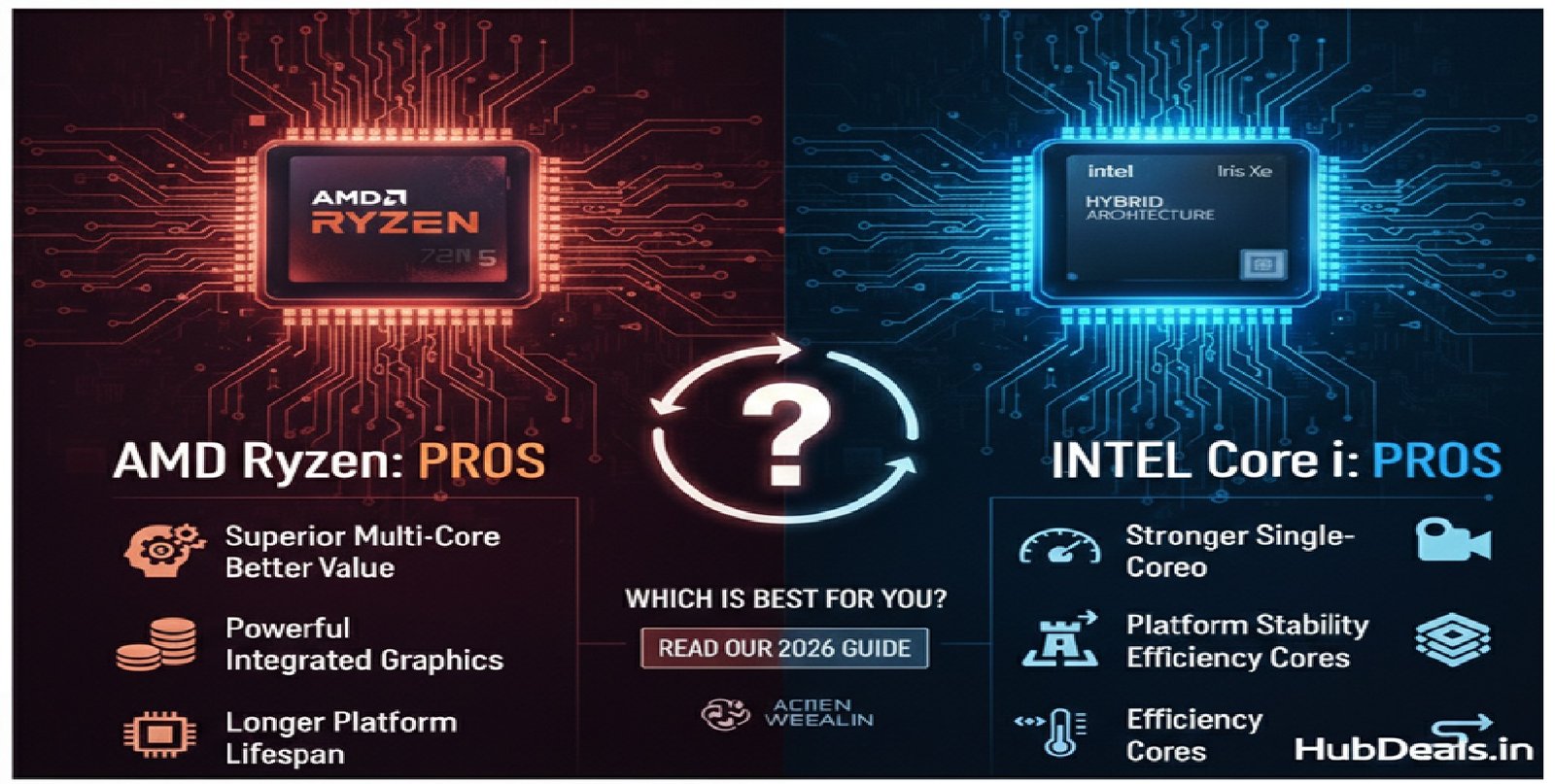
AMD Ryzen vs INTEL Core i
1. AMD Processors (Ryzen Series)
Target Audience: Gamers, content creators, and users seeking the best “bang for your buck” multitasking.
Pros of AMD (Ryzen)
Superior Multi-Core Performance: AMD chips often boast more cores/threads, making them exceptional for heavy multitasking, video editing, 3D rendering, and streaming.
Better Value for Money: Generally, AMD offers more raw computing power per rupee, especially in the mid-range and high-end segments.
Integrated Graphics (APUs): AMD’s APUs (processors with integrated Radeon graphics) are significantly more powerful than Intel’s integrated solutions, making them great for budget gaming without a dedicated GPU.
Platform Longevity: AMD has historically supported its motherboard sockets (like AM4/AM5) for longer, offering better upgrade paths.
Power Efficiency (Newer Generations): Newer Ryzen chips (Zen 4, Zen 5) have made huge strides in power efficiency, especially in laptops.
**
Cons of AMD (Ryzen)
Single-Core Performance (Historically): While catching up fast, Intel often had a slight edge in pure single-core speed, which benefits some older games. (Less of an issue in 2026).
Platform Cost (AM5): While offering longevity, the initial cost of AM5 motherboards and DDR5 RAM can be higher for newer builds.
Driver & Software Optimization (Minor): Occasionally, some niche software or older games might still be slightly better optimized for Intel, though this gap is negligible now.
2. Intel Processors (Core i Series)
Target Audience: Professional users, competitive gamers, and those prioritizing raw single-threaded speed and established platform stability.
Pros of Intel (Core i)
Stronger Single-Core Performance: Intel often holds a lead in raw single-core speed, which is crucial for competitive gaming (high FPS in certain titles) and some professional applications.
Robust Integrated Graphics (Iris Xe): While not as strong as AMD’s APUs, Intel’s Iris Xe graphics are excellent for productivity, casual gaming, and media consumption.
Platform Stability & Optimization: Intel’s platform has a long history, leading to broad software compatibility and highly optimized drivers across the board.
Quick Sync Video: Intel’s Quick Sync technology offers incredibly fast and efficient video encoding/decoding, a big plus for content creators using specific software.
Efficiency Cores (Hybrid Architecture): Intel’s hybrid architecture (Performance-cores + Efficiency-cores) allows for excellent power management, dedicating tasks to the most suitable cores.
**
Cons of Intel (Core i)
Multi-Core Performance (Historically): AMD often provided more multi-core horsepower at a given price point, making Intel less competitive for heavy workstation tasks.
Value Proposition: Intel chips can sometimes be more expensive for equivalent core counts, particularly in the mid-range.
Shorter Platform Lifespan: Intel tends to change its CPU sockets more frequently (e.g., LGA1700 to LGA1851), meaning less upgrade flexibility without a new motherboard.
Power Consumption (High-End): Top-tier Intel CPUs can be power-hungry, requiring robust cooling solutions.
Conclusion: Which Processor Should YOU Buy in 2026?
The best processor for you depends entirely on your primary use case:
For Gaming & Streaming (Budget to Mid-Range): AMD Ryzen often offers more cores and better integrated graphics, making it a fantastic value.
For High-End, Competitive Gaming: Intel Core i might still edge out AMD in pure single-core FPS for some titles, making it the choice for esports pros.
For Content Creation (Video Editing, 3D Rendering): AMD Ryzen’s strong multi-core performance often gives it an advantage.
For Professional Workloads & Stability: Both are excellent, but Intel has a long-standing reputation for enterprise stability and specific optimizations like Quick Sync.
For General Productivity & Budget Builds: Both have strong contenders, but AMD’s APUs offer a great all-in-one solution if you’re skipping a dedicated GPU.
Consider your budget and primary tasks first. Both brands are at the peak of their innovation in 2026, offering incredible options across the board!
“HubDeals.in is India’s premier destination for smart shoppers. We track prices across top retailers like Amazon, Flipkart, and Croma to ensure you never overpay again. Our mission is to simplify your buying journey with real-time price comparisons, expert reviews, and the latest deal alerts.”